
Resume Bullet Points That Get Interviews
How to Write Resume Bullet Points That Get Interviews
Your bullet points are the part of your resume that does the real work. Your header says who you are and your education says where you studied, but your bullets are the evidence that you can do the job.
They are also where most resumes fall apart. Vague verbs, copy-pasted job duties, and zero results make strong candidates look average, both to the recruiter skimming your resume and to the ATS software that parses it first.
This guide gives you a simple formula for writing resume bullet points, before-and-after examples for different fields, and a way to check your own bullets for free.
What Makes a Good Resume Bullet Point?
A good bullet point answers one question for the reader: "So what?"
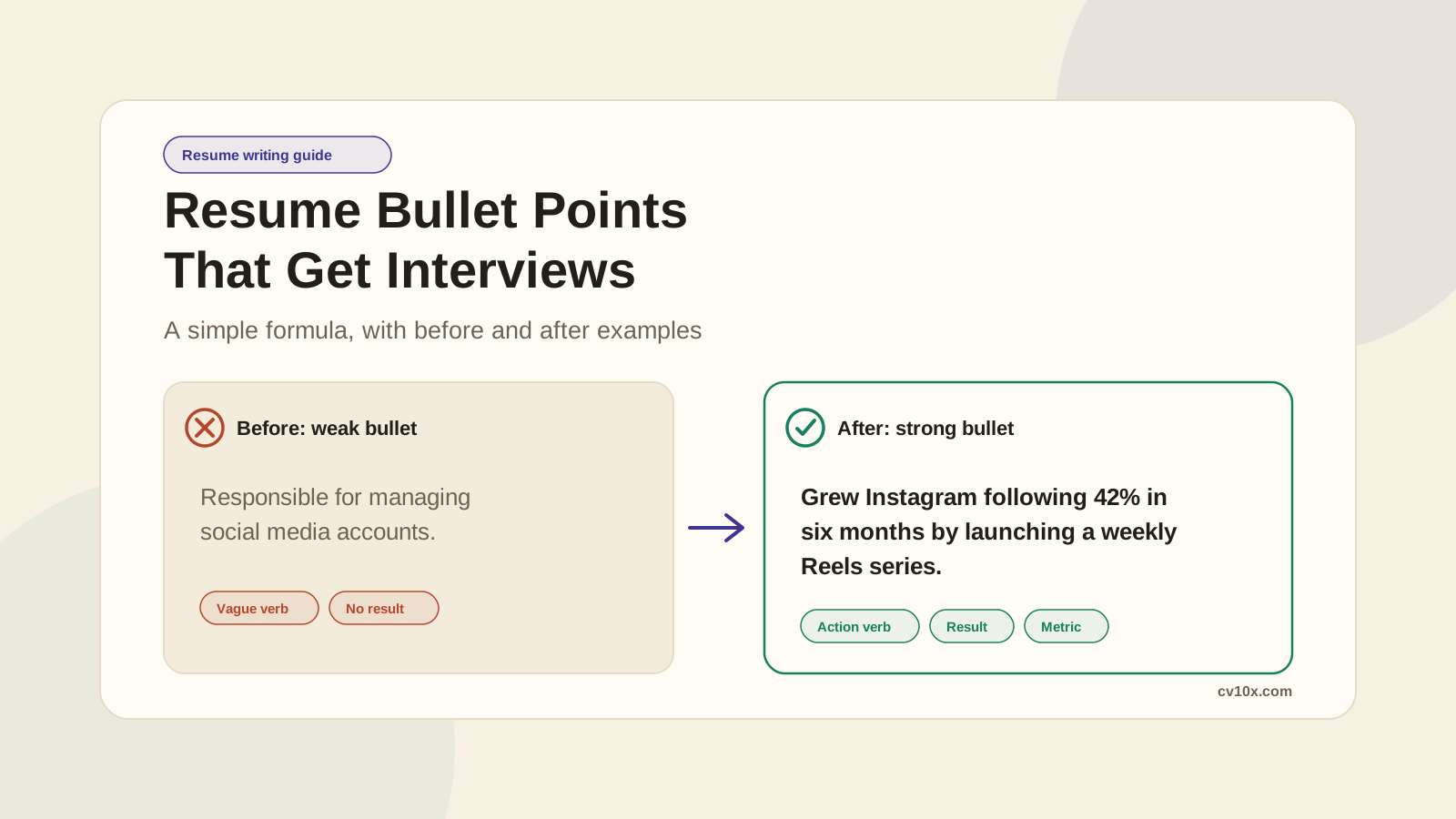
Compare these two bullets for the same job:
- Weak: Responsible for managing social media accounts.
- Strong: Grew Instagram following from 3,200 to 5,900 in six months by launching a weekly Reels series.
The first one tells the recruiter what your job title already implied. The second tells them what you actually achieved, how you did it, and how big the result was.
Strong bullet points share four traits:
- They start with an action verb. "Led," "built," and "reduced" beat "responsible for."
- They are specific. Tools, scale, and context make a claim believable.
- They show a result. What changed because of your work?
- They are short. One to two lines is the target. Longer bullets get skimmed or skipped.
The Resume Bullet Point Formula
If you only remember one thing from this article, make it this:
Action verb + what you did + how you did it + result
Here is the formula in action:
Reduced average ticket resolution time from 9 hours to 6 by building a library of canned responses for the support team.
Breaking it down:
- Action verb: Reduced
- What you did: average ticket resolution time from 9 hours to 6
- How: by building a library of canned responses
- Result: built into the "what you did" part, as a measurable change
You will not always have all four parts. A bullet with a strong verb, a clear task, and a result is still far better than a list of duties. Treat the formula as a checklist, not a rule that every bullet must hit perfectly.
Resume Bullet Point Examples (Before and After)
The examples below show the same experience written weakly and strongly. The numbers are illustrative. Use your own real figures, and never invent metrics you cannot back up in an interview.
Customer Service and Retail
-
Before: Responsible for answering customer calls and emails.
-
After: Resolved 40+ customer calls and emails daily while maintaining a 95% satisfaction score on a team of 12.
-
Before: Handled returns and complaints.
-
After: Turned around escalated complaints by offering tailored solutions, retaining customers who had asked to cancel.
Marketing
-
Before: Helped with social media.
-
After: Grew Instagram following from 3,200 to 5,900 in six months by launching a weekly Reels series and testing posting times.
-
Before: Wrote blog posts for the company website.
-
After: Wrote 24 SEO-focused blog posts in one year, doubling organic traffic to the blog.
Sales
-
Before: Worked on sales targets.
-
After: Exceeded quarterly quota by 18% for three consecutive quarters by prioritizing mid-market accounts and following up within 24 hours.
-
Before: Managed client relationships.
-
After: Managed a portfolio of 35 B2B accounts and renewed 92% of them through proactive quarterly check-ins.
Software and Tech
-
Before: Worked on the backend of the app.
-
After: Cut API response time by 35% by adding Redis caching to the most-queried endpoints, improving load times for 50,000 monthly users.
-
Before: Fixed bugs and wrote tests.
-
After: Increased test coverage from 48% to 82% and reduced production bugs by writing integration tests for the checkout flow.
Admin and Operations
-
Before: In charge of scheduling and filing.
-
After: Streamlined scheduling for a 15-person office using a shared calendar system, saving about 5 hours of admin work per week.
-
Before: Ordered office supplies.
-
After: Renegotiated vendor contracts for office supplies, reducing annual spend by $6,000.
Healthcare
- Before: Took care of patients on the ward.
- After: Managed care for 8 to 10 patients per shift on a 30-bed medical-surgical unit, coordinating with physicians and families to reduce discharge delays.
Finance and Accounting
- Before: Prepared monthly reports.
- After: Automated monthly reporting in Excel and Power BI, cutting close time from 6 days to 4.
Teaching and Education
- Before: Taught English to middle school students.
- After: Taught English to 120 middle school students across five classes, raising average reading scores by 14% over one school year.
How to Add Metrics When You Don't Have Numbers
"Add numbers to your bullets" is the most common resume advice, and also the most frustrating if your job does not come with a dashboard. The good news is that metrics are broader than revenue and percentages.
Look for these instead:
- Scale: How many customers, patients, students, accounts, or team members?
- Frequency: Daily, weekly, per shift, per quarter.
- Time: How much time did you save, or how fast was your turnaround?
- Scope: Budget size, number of locations, regions covered, or systems used.
- Before and after: What was different once you were done?
- Adoption: Did your team or company keep using what you built?
No hard numbers? Describe the outcome plainly:
- Before: Made an onboarding document.
- After: Created an onboarding checklist now used for every new hire on the team.
If you honestly cannot quantify a bullet, a clear and specific description of impact is still better than a vague duty.
Action Verbs to Use (and Phrases to Avoid)
The first word of every bullet sets the tone. Swap passive, generic openings for verbs that show ownership.
Leadership: led, coordinated, directed, mentored, supervised
Improvement: streamlined, reduced, optimized, automated, simplified
Growth: increased, expanded, launched, generated, secured
Analysis: analyzed, identified, evaluated, forecasted, audited
Building: designed, built, developed, implemented, created
Be careful with these weak openers:
- Responsible for
- Helped with
- Worked on
- Duties included
- Assisted in
They describe your job description, not your performance. Replace them with a verb that shows what you personally did.
One more tip: don't start every bullet with the same verb. If your last role has five bullets and all five start with "Managed," mix in some variety.
How ATS Software Reads Your Bullet Points
Before a recruiter reads your bullets, an Applicant Tracking System (ATS) parses them as text. That makes a few formatting habits worth following:
- Use standard bullet characters. A simple round bullet or hyphen is safest. Avoid emojis, icons, and custom symbols.
- Keep bullets in plain text. Avoid putting them inside tables or text boxes.
- Spell out terms and acronyms once. For example, "Search Engine Optimization (SEO)" so both versions can match a keyword search.
- Mirror the job posting's language naturally. If the job asks for "stakeholder management" and you did exactly that, use that phrase instead of a creative alternative.
- Stay consistent. Use the same tense, punctuation style, and date format throughout.
For more on layout risks that can break parsing, see our guide on two-column resumes.
How to Tailor Your Bullet Points to Each Job
Tailoring does not mean rewriting your whole resume for every application. It means adjusting which parts of your experience you emphasize, so your bullets echo what the job asks for.
Here is the same experience written for two different job postings.
Your base bullet: Worked with new customers after they signed up.
For a job focused on customer onboarding and reducing churn: Onboarded 30+ new customers per month through kickoff calls and setup checklists, reducing first-90-day churn by 12%.
For a job focused on high-volume customer support: Handled 60+ support tickets daily for new customers, resolving 80% on the first reply.
Same experience, two angles. The facts stay true, and the emphasis changes to match what each employer is looking for.
A quick way to tailor:
- Read the job posting and underline the skills, tools, and outcomes it mentions.
- Pick the two or three bullets in your resume that are closest to those requirements.
- Rewrite them to use the same language and to highlight the matching results.
- Move your strongest, most relevant bullets to the top of each role.
Check Your Bullet Points for Free with CV10x
Writing strong bullets is easier when you can see what is weak. That is what CV10x is built for.
Paste in a job posting and upload your resume, and CV10x's ATS check analyzes your content, layout, metrics, and bullet points. It compares your resume with the job's requirements, skills, and experience, then gives you a full report with specific suggestions. When you are ready to fix things, one button applies the improvements with AI.
It is free, and it takes a lot of the guesswork out of whether your resume is actually ready to send. If your goal is more interviews, checking your bullets before you apply is one of the fastest ways to get there.
Practical Rules to Follow
- Start every bullet with a strong action verb.
- Aim for one to two lines per bullet.
- Include a result or outcome in as many bullets as you honestly can.
- Use numbers where they are real, and clear descriptions where they are not.
- Lead each role with your most relevant, impressive bullets.
- Match the language of the job posting where it truthfully applies to you.
- Keep your formatting simple: standard bullet characters, consistent tense, no tables.
- Never invent or exaggerate. Every bullet should hold up in an interview.
Final Takeaway
Resume bullet points are not a list of things you were responsible for. They are proof of what you accomplished.
Use a strong verb, say what you did, show the result, and keep it short. Then tailor your best bullets to each job so the match is obvious to both the software and the person reading.
Do that consistently and your resume stops sounding like a job description and starts sounding like a reason to interview you.
FAQ: Resume Bullet Points
How many bullet points should I have per job?
Three to six is a good range for most roles. Give more space to recent or highly relevant jobs, and keep older roles to two or three bullets. Quality matters more than quantity, so cut any bullet that does not add something new.
How long should a resume bullet point be?
Aim for one to two lines. If a bullet runs to three lines, it is usually trying to say too much. Split it in two or trim the detail that does not support the main result.
Should resume bullet points be in past or present tense?
Use past tense for previous jobs and present tense for your current role. Whichever you choose, stay consistent within each job.
Should resume bullet points end with a period?
Either style works as long as you are consistent. Many people skip periods for short fragments and use them if bullets are full sentences.
Do I need a metric in every bullet point?
No. Aim to include results in most of your bullets, but not at the cost of accuracy. A clear, specific description of the outcome is better than a made-up number.
How does an ATS read resume bullet points?
An ATS extracts your bullets as plain text and looks for keywords, skills, and job titles that match the role. Simple bullet characters, standard section headings, and natural use of the job posting's language help your bullets parse and match correctly.
What is the best formula for resume bullet points?
A reliable formula is action verb + what you did + how you did it + result. Not every bullet will include all four parts, but using it as a checklist makes your bullets stronger and more specific.