
Resume Keywords for ATS: How to Find, Match & Add Them (Without Stuffing)
10/24/2026•CV10x Team
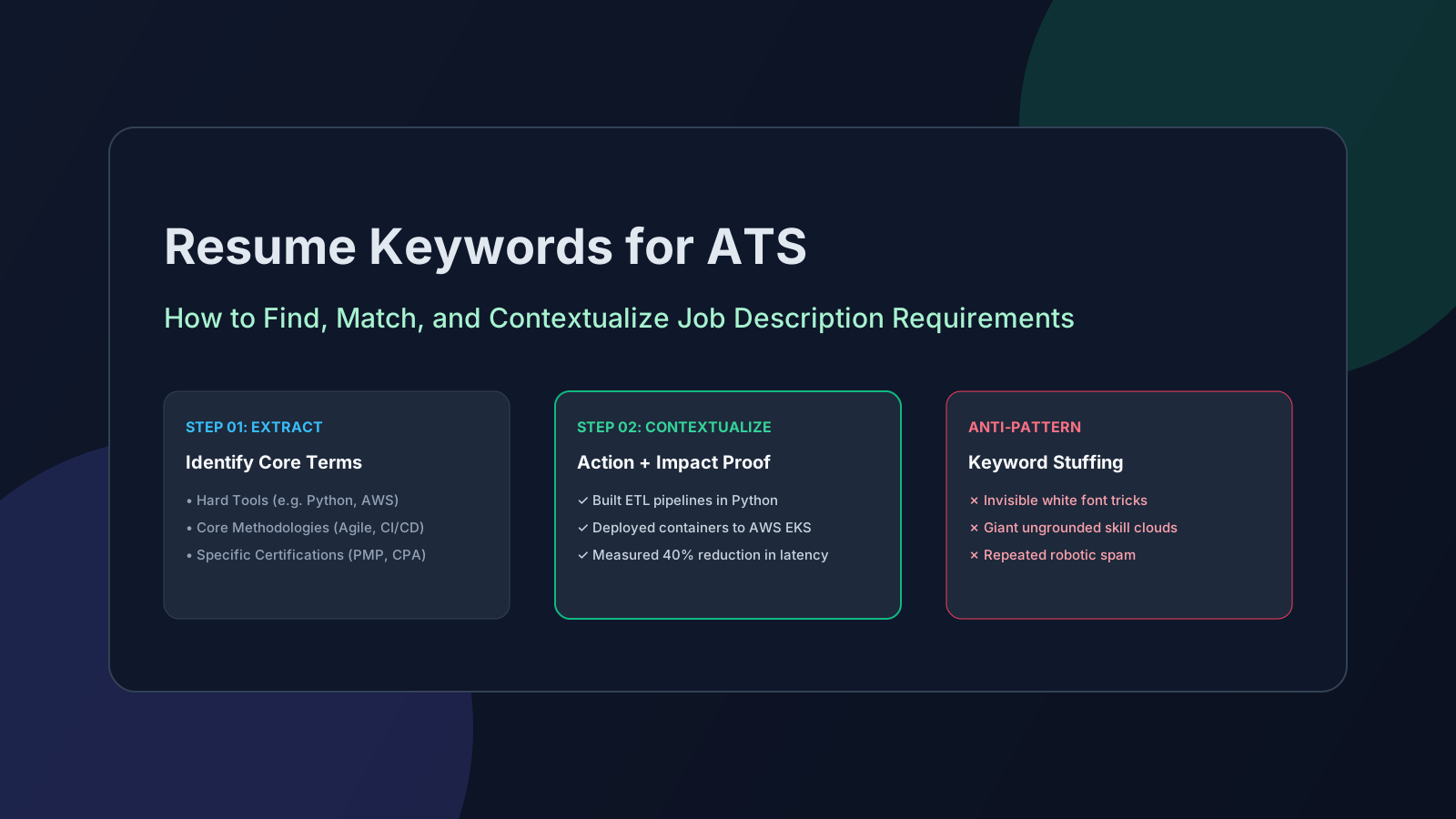
ATSResume KeywordsResume TipsJob Search
You have the experience, the education, and the drive. Yet after applying to dozens of online job postings, your inbox remains empty.
In over 80% of cases, the disconnect comes down to keyword alignment.
When an employer posts a job opening on platforms like Workday, Greenhouse, or Lever, recruiters configure search filters around specific technical tools, methodologies, certifications, and core competencies. If your resume describes the right work using the wrong vocabulary, the Applicant Tracking System (ATS) will rank your application below candidates who used the exact language of the job description.
However, many job seekers make the opposite mistake: keyword stuffing—cramming long lists of ungrounded buzzwords into their resume. While this might trigger an algorithm match, human recruiters reject stuffed resumes within seconds of opening them.
In this guide, you will learn how ATS keyword matching actually works, how to extract primary terms from any job posting, how to integrate keywords naturally into achievement-driven bullet points, and how to audit your match score before applying.
Contrary to popular belief, modern applicant tracking systems do not simply count how many times a word appears. Enterprise parsing engines (like Sovren and semantic search layers) evaluate keywords across four distinct dimensions:
┌────────────────────────────────────────────────────────────────────────┐
│ 1. Hard Skill & Technology Exact Match                                  │
│    Specific software, programming languages, platforms (e.g., React)  │
├────────────────────────────────────────────────────────────────────────┤
│ 2. Section Placement & Contextual Grounding                            │
│    Is the term supported by verbs and metrics in Work Experience?       │
├────────────────────────────────────────────────────────────────────────┤
│ 3. Recency & Career Timeline Weighting                                  │
│    Did you use the technology in your current role, or 8 years ago?    │
├────────────────────────────────────────────────────────────────────────┤
│ 4. Phrasing & Acronym Variations                                        │
│    Does the parser recognize both "Search Engine Optimization" & "SEO"?│
└────────────────────────────────────────────────────────────────────────┘
When dissecting a job description, categorize target keywords into four buckets:
These are mandatory prerequisites that determine whether you can execute the role on day one.
These describe your working framework and professional philosophy.
For regulated or specialized professions, certifications serve as binary knockout criteria.
Interpersonal attributes that describe how you collaborate.
To find the keywords that recruiters actually filter by, use this 3-step extraction technique:
[ Step 1: Scan "Requirements" ] ──> Identify non-negotiable tools & certifications
              │
              ▼
[ Step 2: Note Frequency ]      ──> Terms repeated 2+ times in the post are core priorities
              │
              ▼
[ Step 3: Match to Your Work ]  ──> Ground each matching term in an honest career bullet
"We are seeking an experienced Product Marketing Manager to lead go-to-market (GTM) strategy for our B2B SaaS platform. You will collaborate closely with Product Management and Sales to develop customer personas, conduct competitive intelligence, and execute product launches. Proficiency with HubSpot, Salesforce, and Mixpanel required. Experience with content strategy and managing KPIs is essential."
Listing keywords in a standalone "Skills" section helps the parser, but human recruiters evaluate candidate credibility based on your Work Experience bullets.
Use the Google XYZ Achievement Formula to combine target keywords with measurable proof:
$$\text{Accomplished } [X] \text{ as measured by } [Y], \text{ by doing } [Z]$$
A widely circulated internet trick suggests pasting blocks of keywords in tiny white font at the bottom of a resume. Modern ATS parsers strip all color styling and convert documents into raw plain text. When the recruiter opens your application, the white text appears as an obvious, messy block of spam keywords, leading to immediate blacklisting.
Repeating the same keyword ("Python developer writing Python code with Python scripts") lowers readability for human recruiters and triggers spam filters. Mention critical tools 2–4 times in meaningful, varied contexts.
If an ATS recruiter searches for "Certified Public Accountant", but your resume only says "CPA", the parser might miss the match depending on its dictionary configuration.
Never insert keywords for technologies you have never used. Recruiters and technical interviewers test core skills during initial phone screens. If you cannot speak in detail about a tool on your resume, it will disqualify you immediately.
To maximize both ATS parsing scores and recruiter reading speed, distribute your keywords across four strategic sections:
┌────────────────────────────────────────────────────────────────────────┐
│ HEADER / TITLE: Target Job Title (e.g., Senior Full-Stack Engineer)   │
├────────────────────────────────────────────────────────────────────────┤
│ PROFESSIONAL SUMMARY: 3–4 lines highlighting core domain keywords &    │
│ career achievements                                                    │
├────────────────────────────────────────────────────────────────────────┤
│ CORE COMPETENCIES / SKILLS: Categorized technical skills & tools       │
│ • Languages: TypeScript, Python, SQL                                   │
│ • Cloud & DevOps: AWS, Docker, Kubernetes, CI/CD                       │
│ • Frameworks: React, Next.js, FastAPI, Node.js                         │
├────────────────────────────────────────────────────────────────────────┤
│ WORK EXPERIENCE: Contextualized bullets using the Google XYZ formula   │
│ with hard tools paired with percentages, revenues, and scale           │
└────────────────────────────────────────────────────────────────────────┘
For detailed guidance on structuring clean, single-column sections that parsers read linearly, review our guide on why two-column resumes hurt ATS parsing.
Manually cross-referencing your resume against every line of a job description takes hours and leaves room for oversight.
You can instantly audit your document with the free CV10x ATS Resume Checker:
ATS keywords are specific skills, software programs, certifications, job titles, and industry methodologies that an employer includes in a job posting. When you apply, the Applicant Tracking System scans your resume to calculate how many of these required qualifications you possess.
Review the "Requirements", "Qualifications", and "Responsibilities" sections of the job posting. Look for technical software tools (e.g., Excel, Python, Salesforce), certifications (e.g., PMP, CPA), and functional phrases repeated multiple times. Terms that appear under "Must-Have" or "Required Qualifications" are your highest-priority keywords.
Keyword stuffing is the practice of unnaturally cramming keywords into a resume to trick automated filters—such as creating giant, context-free lists of buzzwords or hiding text in white font. While it might pass an initial text filter, it results in immediate rejection when a human recruiter reviews the disorganized application.
Core technical skills should ideally appear 2 to 4 times across different sections: once in your Skills section, once in your Professional Summary (if it represents a primary specialization), and 1 to 2 times within specific Work Experience bullet points that show how you used the skill to achieve results.
Some legacy ATS systems only recognize either the full spelled-out phrase or the acronym. To ensure 100% compatibility across all ATS platforms, always write both: for example, "Project Management Professional (PMP)" or "Search Engine Optimization (SEO)".