
How ATS Resume Screening Actually Works (And the Truth About Rejections)
If you have spent any time on LinkedIn or career forums, you have likely encountered this terrifying statistic:
"75% of resumes are automatically rejected by an ATS robot before a human recruiter ever sees them."
It is cited in hundreds of articles, TikTok videos, and resume-writing advertisements. It paints a picture of an autonomous artificial intelligence ruthlessly deleting three out of every four applications because of a font choice, a margin size, or an awkward bullet point.
There is just one problem: it is largely a myth.
In reality, modern Applicant Tracking Systems (ATS) like Workday, Greenhouse, Taleo, and Lever rarely auto-reject candidates based on resume formatting. Instead, understanding what the software actually does—and how human recruiters use it to manage overwhelming applicant volume—is the secret to making sure your application gets read.
In this guide, we trace the origins of common ATS myths, break down the four real stages of resume screening, examine what recruiters actually see on their dashboards, and share proven steps to ensure your resume rises to the top of the queue.
Debunking the Myths: Where Did the "75% Rejection" Claim Come From?
To understand how ATS software works, we must first clear away the pervasive misinformation surrounding automated hiring.
1. The 75% Auto-Rejection Myth
Investigations into career industry data trace the "75% of resumes rejected by ATS" statistic back to around 2012, originally popularized by a startup named Preptel. Preptel was selling a commercial resume-optimization tool designed to help applicants "beat the bot." To create urgent demand for their product, marketing copy warned candidates that three-quarters of resumes were silently discarded by automated algorithms.
Over the next decade, career blogs and resume services repeatedly copied the statistic without verifying its source or checking whether modern recruiting systems actually work that way.
2. What Modern Recruiter Research Actually Shows
In a comprehensive industry survey conducted by Enhancv, researchers interviewed 25 corporate recruiters across tech, healthcare, finance, and consumer goods—representing companies ranging from 120 to over 50,000 employees using platforms like Workday, Greenhouse, iCIMS, and SuccessFactors:
- 92% of recruiters (23 out of 25) confirmed that their ATS does NOT automatically reject resumes based on formatting, layout, or resume text content.
- Automatic rejections that do occur are triggered almost exclusively by explicit knockout questions (such as work visa authorization, required professional licenses, or relocation willingness).
- Compatibility scores and keyword filters are used to sort and prioritize candidates in the queue—not to delete them.
3. The Real Problem: The Harvard "Hidden Workers" Study
While resumes are rarely discarded by malicious bots, automated filters do create massive inefficiencies in corporate hiring.
In a landmark joint study by Harvard Business School and Accenture titled "Hidden Workers: Untapped Talent" (Fuller et al., 2021), researchers found that 88% of surveyed executives acknowledged that their automated hiring platforms inadvertently filter out qualified, high-potential candidates.
Why? Not because of fonts or margins, but because hiring teams configure overly rigid candidate prerequisites (e.g., requiring unbroken employment histories, specific arbitrary degree titles, or strict minimum years of experience that disqualify talented workers).
The 4 Real Stages of ATS Resume Screening
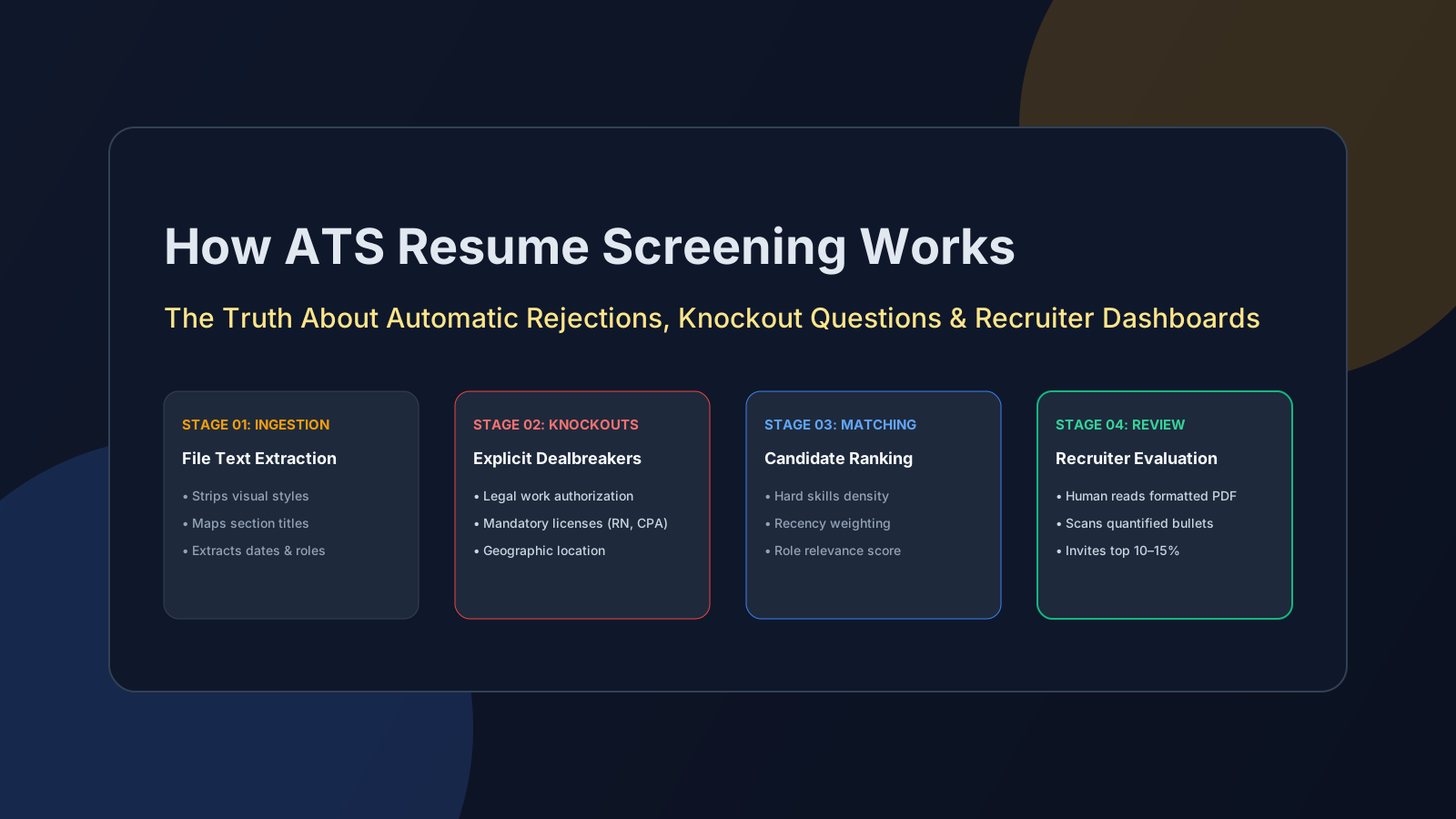
When you click "Submit Application" on a corporate careers portal, your resume travels through a structured four-stage evaluation pipeline:
[ STAGE 1: INGESTION ] ───────> Strips visual styles, extracts digital text glyphs,
                                maps standard headings (Experience, Education).
          │
          ▼
[ STAGE 2: KNOCKOUT GATES ] ───> Evaluates binary eligibility questions:
                                Work authorization, licenses (CPA, RN), location.
          │
          ▼
[ STAGE 3: MATCHING & RANK ] ─> Compares text against job description keywords.
                                Assigns relevance score (0–100%) to order queue.
          │
          ▼
[ STAGE 4: HUMAN REVIEW ] ────> Recruiter opens top-ranked candidate profiles,
                                reviews formatted vector PDF, and selects interviews.
Stage 1: Document Parsing & Text Extraction
The ATS ingests your file (PDF or DOCX) and uses a parsing library to extract its underlying text stream.
- What the parser looks for: Contact details (phone, email, LinkedIn), job titles, employer names, employment dates, degree titles, and section headings.
- The risk: If you submit an image-based PDF (e.g., exported as a flattened JPEG from Canva or Photoshop), the parser extracts zero words. For detailed instructions on avoiding this pitfall, read our guide on whether ATS can read PDF resumes.
Stage 2: The Knockout Question Gate
Before an algorithm evaluates your resume bullets, the system checks your answers to the application form's knockout questions.
Knockout questions are binary (yes/no or multiple-choice) criteria configured by the hiring team to eliminate unqualified applicants immediately. Common knockout criteria include:
- "Are you legally authorized to work in the United States without sponsorship?"
- "Do you possess an active Registered Nurse (RN) license in the state of New York?"
- "Are you willing to work on-site 3 days per week in our Chicago office?"
- "Do you have at least 3 years of experience managing enterprise budgets?"
Critical Fact: When a candidate receives an instant rejection email 10 minutes after applying, it is almost never because an AI read their resume. It is because they answered "No" to a mandatory knockout question.
Stage 3: Keyword Scoring & Candidate Queue Ordering
Once you pass the knockout gates, the ATS parses your text and compares it against the job description to calculate an Applicant Match Score or Relevance Grade.
Platforms like Workday, Lever, and Greenhouse evaluate:
- Hard Skill Overlap: Did you include the specific frameworks, platforms, and technical tools requested in the posting?
- Title Alignment: Does your recent job title resemble the target role?
- Experience Recency: Are your matching skills demonstrated in your most recent positions?
To understand how algorithms weigh these metrics, review our breakdown of what an ATS score means and how key metrics are calculated.
Stage 4: Recruiter Dashboard Review
Here is what a recruiter actually sees when they log into their ATS dashboard in the morning:
┌────────────────────────────────────────────────────────────────────────┐
│ REQUISITION: Senior Product Designer (#REQ-4091)                       │
│ Total Applicants: 342  |  Knocked Out: 110  |  Active Pool: 232        │
├────────────────────────────────────────────────────────────────────────┤
│ SORT BY:  [ Match Score ▼ ]   [ Application Date ]   [ Recruiter Star ]│
├────────────────────────────────────────────────────────────────────────┤
│ 1. Elena Rostova     │ 94% Match │ Figma, Design Systems, React, B2B   │
│ 2. Marcus Chen       │ 91% Match │ Figma, User Research, Prototyping   │
│ 3. Sarah Jenkins     │ 88% Match │ Design Systems, Mobile iOS, Figma   │
│ ...                                                                    │
│ 45. David Miller     │ 62% Match │ Photoshop, Graphic Design, Web UI   │
│ ...                                                                    │
│ 190. Alex Rivera     │ 34% Match │ Missing 8 core required tools       │
└────────────────────────────────────────────────────────────────────────┘
The recruiter does not read all 342 applications. They start at the top of the sorted queue (candidates with 85%+ compatibility) and open the original formatted PDF resumes.
They typically review the top 15 to 30 candidates, conduct 6 to 10 phone screens, and invite 3 to 5 finalists to interview.
If your resume scored 55% because you left out core keywords, your application was not "rejected by a robot"—it was simply pushed to page 12 of the recruiter's dashboard, where a human never scrolled far enough to see it.
Why Good Candidates Get "Ghosted" (The Real Numbers)
Job seekers often assume silence means their resume failed parsing. The real culprit is application volume overload:
- A typical corporate job opening attracts 250 to 500+ applications.
- High-profile remote tech roles frequently exceed 1,500+ applications within 72 hours.
- A single corporate recruiter often manages 15 to 25 open requisitions simultaneously.
Recruiters spend an average of 6 to 10 seconds reviewing an individual resume. Because their time is constrained, they rely on ATS match scores to filter out the noise and identify the top 10% of applicants who demonstrate clear, quantifiable alignment with the job requirements.
5 Practical Steps to Pass ATS Screening Every Time
To ensure your application reaches the recruiter's screen and earns an interview callback, follow this five-point protocol:
1. Match Your Vocabulary to the Job Posting
Never use creative synonyms for standardized industry skills. If the job description asks for TypeScript, writing JavaScript is not enough. Review our guide on finding and matching resume keywords for ATS to learn how to identify primary terms.
2. Keep Your Layout Linear and Single-Column
Avoid splitting your resume into parallel columns or sidebars. Multi-column resumes risk interleaving skills into employment dates, confusing the parser. Stick to a clean single-column format as outlined in why two-column resumes hurt ATS parsing.
3. Use Standardized Section Headings
ATS parsing dictionaries map your experience based on familiar titles. Avoid creative headings like "My Career Journey" or "Professional Footprint". Use standard headings:
- Work Experience (or Professional Experience)
- Education
- Skills (or Core Competencies)
- Certifications
4. Provide Clean, Copyable Text Contact Details
Never place your email address or phone number inside Microsoft Word headers or footers, and never replace text labels with phone or mail icons. As explained in our analysis of why decorative icons kill ATS scores, icons frequently scramble contact extraction.
5. Always Submit a Selectable Vector PDF
Export your resume directly from your word processor or an ATS-tested builder. Verify that you can click, drag, and copy text from the resulting PDF before uploading.
Test Your Resume Before Applying
You don't have to guess how an Applicant Tracking System will parse your resume.
Using the free CV10x ATS Resume Checker, you can test your document against the same parsing mechanics used by enterprise employers:
- Upload your PDF or Word document.
- Paste your target job description.
- Receive an instant, transparent compatibility report: See your 0–100% match score, verify text extractability, check header mapping, and review missing keywords.
- Fix gaps in one click: Open our visual editor to adjust bullet points with AI assistance and export a recruiter-ready PDF.
Frequently Asked Questions
Does an ATS automatically reject resumes?
In over 90% of cases, no. Modern ATS platforms do not auto-reject candidates based on resume formatting or text content. The only instances of automatic rejection occur when an applicant answers "No" to a mandatory knockout question (such as legal work authorization or required state licenses).
What is a knockout question on a job application?
A knockout question is a mandatory multiple-choice or yes/no question on an application form that checks basic eligibility. If an applicant does not meet a mandatory threshold (e.g., "Can you work legally in the country without sponsorship?"), the ATS automatically routes the application to the rejected queue without human review.
How does an ATS score resumes?
An ATS calculates a relevance score (typically 0% to 100%) by comparing the text of your resume to the keywords, technical skills, certifications, and job titles in the employer's job description. Candidates with higher scores appear at the top of the recruiter's candidate list.
Can recruiters see my original formatted resume?
Yes. Modern applicant tracking systems (such as Workday, Greenhouse, Lever, and Taleo) generate structured profile fields from your text while simultaneously embedding a visual viewer of your original uploaded PDF or Word document for the recruiter to read.
What is the origin of the "75% of resumes rejected by ATS" statistic?
The claim originated around 2012 from Preptel, an early resume-optimization company marketing its software to job seekers. Modern recruiter surveys, including Enhancv's 2025/2026 study of 25 corporate recruiters, have thoroughly debunked the claim, showing that human bandwidth and application volume—not automated AI rejection—are why resumes go unread.