
How to Write a Software Engineer Resume That Passes ATS Screening
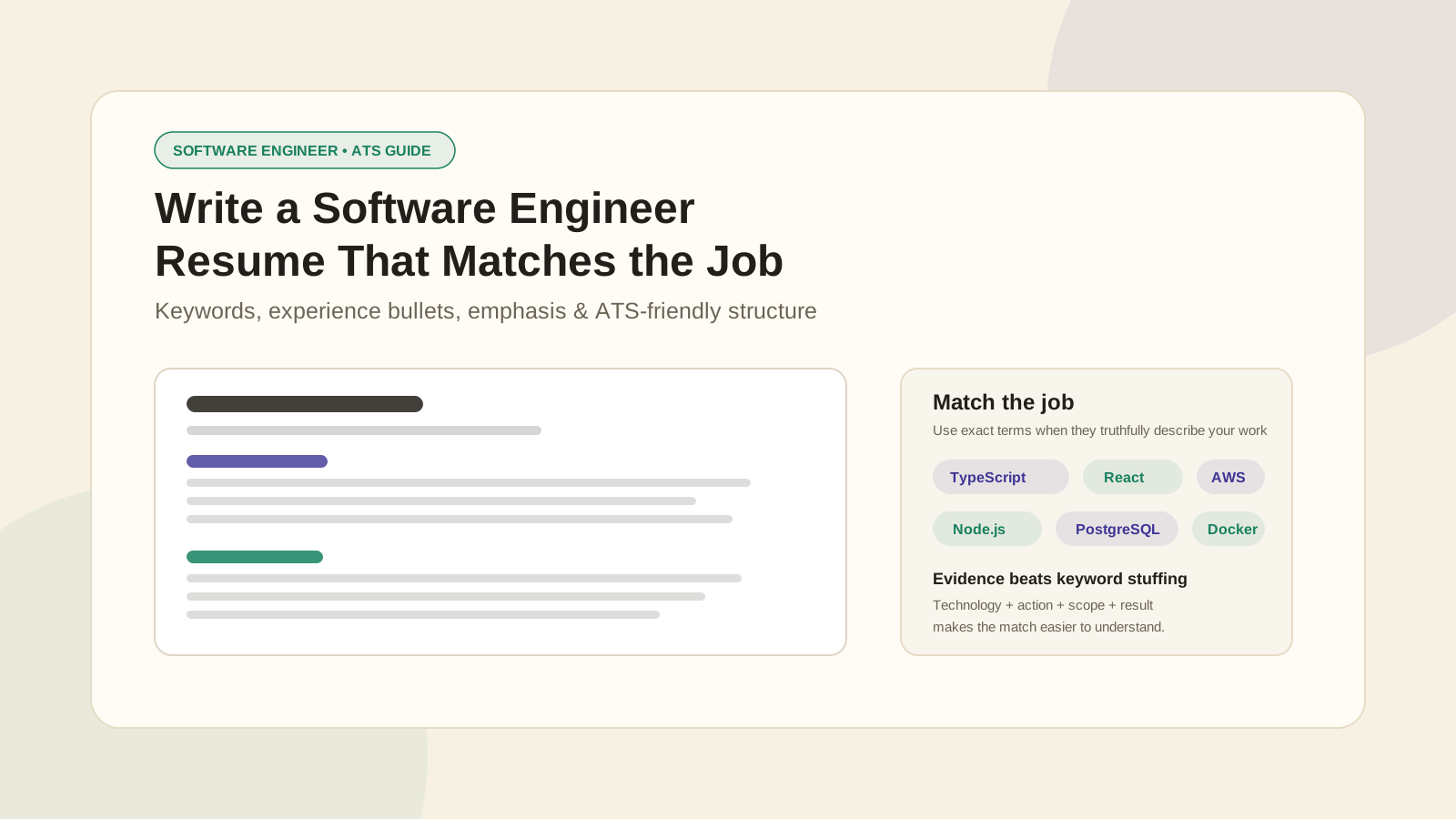
Your Software Engineer Resume Has the Right Skills—But Are They Written for ATS?
You can be an excellent software engineer and still have a resume that performs poorly in an Applicant Tracking System (ATS).
The problem isn't always missing skills.
Sometimes the problem is how those skills are written, where they appear, and whether your experience actually connects them to the work you have done.
A resume that says:
"Worked on modern web applications."
doesn't tell an ATS—or a recruiter—much.
A stronger version might say:
"Built customer-facing web applications using React, TypeScript, and Node.js, integrating REST APIs and PostgreSQL to support high-volume user workflows."
The second version gives the reader something concrete:
- The technologies
- The engineering work
- The context
- The relationship between the technology and the experience
That's the foundation of an ATS-friendly software engineer resume.
What Makes a Software Engineer Resume ATS-Friendly?
An ATS-friendly software engineer resume has two jobs.
First, it needs to be technically readable.
Second, it needs to communicate relevant evidence from your experience.
Current resume guidance for software engineering roles consistently emphasizes explicit technical terminology—languages, frameworks, cloud platforms, databases, infrastructure, APIs, testing and engineering practices—rather than vague descriptions such as "modern technologies."
A strong resume therefore combines:
- Clean, parseable formatting
- Standard section headings
- Explicit technical skills
- Job-description terminology
- Relevant experience
- Measurable results
- Natural keyword placement
The goal isn't to trick the ATS.
The goal is to make your actual qualifications easy to identify.
Start With the Job Description, Not Your Resume
One of the biggest mistakes software engineers make is writing one generic resume and sending it to every company.
Instead, start with the job description.
Suppose the posting asks for:
TypeScript, React, Node.js, AWS, PostgreSQL, Docker, REST APIs and CI/CD.
Don't immediately copy all eight terms into your Skills section.
First ask:
Which of these have I actually used?
Then ask:
Where in my experience can I prove that?
For example:
| Job requirement | Resume evidence |
|---|---|
| TypeScript | Built application features with TypeScript |
| React | Developed reusable React components |
| Node.js | Built backend services with Node.js |
| AWS | Deployed production workloads on AWS |
| PostgreSQL | Designed and optimized PostgreSQL queries |
| Docker | Containerized services with Docker |
| REST APIs | Designed and integrated REST APIs |
| CI/CD | Automated testing and deployment pipelines |
This is much stronger than simply creating a giant list of technologies.
Use the Exact Technical Terminology When It Is True
ATS matching can depend on the actual text contained in your resume.
If a job description says:
"Experience with PostgreSQL"
and your resume only says:
"Experience with relational databases"
you may be describing the same general area, but PostgreSQL is much more useful when it accurately represents your experience.
The same principle applies to:
- TypeScript
- JavaScript
- React
- Next.js
- Node.js
- Python
- Java
- AWS
- Azure
- Docker
- Kubernetes
- PostgreSQL
- MongoDB
- Redis
- Kafka
- GraphQL
- REST APIs
- CI/CD
- Terraform
- Microservices
These are concrete technical terms that frequently appear in software engineering job descriptions.
Don't replace a specific technology with a vague category.
Instead of:
Cloud platform
write:
AWS
when AWS is what you actually used.
Instead of:
JavaScript framework
write:
React
when React is what you actually used.
The Most Important Part: Your Experience Section
A Skills section tells the recruiter what you know.
Your Experience section should show what you actually did with it.
Compare:
Weak
Developed backend applications using Node.js.
Better
Developed backend services using Node.js and TypeScript to support customer-facing SaaS workflows.
Stronger
Developed Node.js and TypeScript backend services for a customer-facing SaaS platform, reducing API response time by 32% through query optimization and caching.
The strongest version contains four things:
Action + technology + context + result
This pattern works extremely well for software engineering resumes.
A Simple Formula for Better Engineering Bullets
Use:
Action + What you built + Technology + Scale/Context + Result
For example:
Designed and implemented REST APIs using Node.js and TypeScript for a multi-tenant SaaS platform, supporting customer authentication and billing workflows.
Or:
Optimized PostgreSQL queries and introduced Redis caching, reducing average API latency by 41%.
Or:
Containerized backend services with Docker and automated testing and deployments through CI/CD, reducing manual deployment steps.
Or:
Migrated legacy services to AWS, improving deployment reliability and reducing infrastructure maintenance overhead.
The exact technologies should change depending on the job.
Don't Just List Technologies—Connect Them to Results
This is where many software engineer resumes become weak.
A skills list like this:
React, Node.js, AWS, Docker, PostgreSQL, Kubernetes
is useful, but it doesn't prove much.
Compare it with:
Built React and TypeScript interfaces backed by Node.js REST APIs, deployed production services through Docker and AWS, and optimized PostgreSQL queries to improve application performance.
Now the technologies have context.
The resume is communicating:
I know this technology → I used it → I used it for something meaningful.
That's much stronger than keyword repetition.
How Many Times Should a Keyword Appear?
There is no universal rule such as:
"Put React exactly five times."
Don't optimize for an arbitrary keyword density.
Instead, optimize for coverage and evidence.
For an important technology, a useful structure can be:
Skills
React, TypeScript, Node.js, AWS
Experience
Built customer-facing applications using React and TypeScript.
Another relevant bullet
Integrated Node.js REST APIs and deployed services through AWS.
Now the important terms are present in both the skills inventory and the experience evidence.
That's much more natural than repeating:
React, React, React, TypeScript, TypeScript...
Keyword stuffing can make a resume harder for humans to read and does not demonstrate proficiency.
Choose Keywords Based on the Job, Not a Generic Keyword List
A software engineer resume should not contain every technology you have ever touched.
Imagine two jobs.
Job A — Frontend Engineer
The posting emphasizes:
- React
- TypeScript
- Next.js
- CSS
- Accessibility
- Component architecture
- Frontend performance
Your resume should make those areas easy to find.
Job B — Backend Engineer
The posting emphasizes:
- Java
- Spring Boot
- PostgreSQL
- Kafka
- Microservices
- Distributed systems
- AWS
Your backend experience should receive more emphasis.
The same engineer can legitimately have different versions of their resume for different roles.
You're not changing your career history.
You're changing which relevant evidence you emphasize.
Use a Dedicated Technical Skills Section
Don't force the ATS to discover your entire stack by reading every bullet.
Make your technical skills explicit.
For example:
Technical Skills
- Languages: TypeScript, JavaScript, Python, Java, SQL
- Frontend: React, Next.js, HTML, CSS
- Backend: Node.js, Express, REST APIs, GraphQL
- Databases: PostgreSQL, MongoDB, Redis
- Cloud & DevOps: AWS, Docker, Kubernetes, Terraform, CI/CD
- Testing: Jest, Playwright, Cypress
- Tools: Git, GitHub, Jira
Then use the most relevant technologies again inside your experience section.
Put the Most Relevant Skills Where They Matter
If the job specifically asks for:
Python, AWS, Kubernetes and PostgreSQL
don't bury those terms at the very bottom of your resume.
Make them easy to find.
A useful structure is:
Summary → Skills → Experience → Projects → Education
The exact order can vary with seniority and career history, but important technical information shouldn't be hidden.
Use Bold Text for Human Scanning
ATS optimization isn't only about machines.
Eventually, a person may read the resume.
Selective emphasis can help recruiters quickly identify important information:
- Designed REST APIs using Node.js and TypeScript, supporting authentication and billing workflows.
- Optimized PostgreSQL queries and introduced Redis caching, reducing API latency by 42%.
- Automated production deployments using Docker, AWS, and CI/CD.
Don't bold every word.
The purpose of emphasis is to create a visual hierarchy for the human reader—not to increase keyword density.
Quantify Your Engineering Impact
"Developed features" is difficult to evaluate.
Numbers make engineering work easier to understand.
Instead of:
Improved application performance.
Try:
Reduced average API response time by 38%.
Instead of:
Worked on a large application.
Try:
Supported a SaaS platform serving 100K+ monthly users.
Instead of:
Improved testing.
Try:
Increased automated test coverage from 45% to 82%.
Useful metrics include:
- Latency
- Throughput
- Users
- Requests
- Uptime
- Deployment frequency
- Test coverage
- Build time
- Infrastructure cost
- Processing time
- Database size
- Number of services
- Incidents
- Team size
If you don't have an exact number, don't invent one.
A truthful qualitative result is better than a fabricated metric.
Use Strong Engineering Verbs
Avoid starting every bullet with:
Responsible for...
Instead use verbs that describe what you actually did:
- Built
- Designed
- Implemented
- Architected
- Developed
- Migrated
- Optimized
- Automated
- Refactored
- Integrated
- Deployed
- Debugged
- Reduced
- Improved
- Scaled
- Maintained
- Led
For example:
Weak
Responsible for maintaining APIs.
Better
Maintained and optimized Node.js REST APIs supporting customer-facing services.
Even better
Optimized Node.js REST APIs, reducing average response latency by 28%.
Don't Try to Match Every Keyword
This is an important distinction.
Suppose the job description contains:
Python, Java, Go, React, Angular, AWS, Azure, Kubernetes, Docker, Kafka, Terraform...
You shouldn't add technologies you haven't used simply because they're in the posting.
An ATS-friendly resume should be:
Relevant + Truthful + Specific
not:
Maximum number of keywords.
A recruiter can ask you about anything you list.
If you can't explain how you used a technology, it probably shouldn't be presented as a core skill.
What About Synonyms and Abbreviations?
When a term has common variations, you can sometimes include both naturally.
For example:
JavaScript (JS)
or:
Continuous Integration/Continuous Deployment (CI/CD)
or:
Amazon Web Services (AWS)
The important thing is that the resume remains readable.
Don't create unnatural sentences just to include every possible variation.
Your Resume Format Still Matters
Keyword optimization cannot compensate for a resume that an ATS cannot parse correctly.
A clean software engineer resume should generally favor:
- A simple structure
- Standard section headings
- Readable typography
- Normal text
- Clear dates
- Clear job titles
- Consistent formatting
- A predictable reading order
Avoid unnecessarily complicated layouts involving:
- Text boxes
- Decorative graphics
- Skill bars
- Excessive icons
- Complex tables
- Unusual section structures
A single-column structure is generally the safer choice for online applications because it gives the parser one straightforward reading path.
This is especially relevant because resume parsing problems can occur when visual layout and underlying text order don't match.
The 30-Second Software Engineer Resume Test
Before submitting, pretend you're a recruiter.
Look at your resume for a few seconds.
Can you immediately identify:
1. Who is this person?
Software Engineer? Backend Engineer? Full Stack Engineer?
2. What is their stack?
Python? Java? React? TypeScript? AWS?
3. What have they actually built?
APIs? SaaS applications? Distributed systems? Mobile applications?
4. What impact did they have?
Performance? Scale? Reliability? Cost? Revenue?
5. Does their experience match this specific job?
If the answers aren't obvious, the resume probably needs stronger positioning.
A Complete Example
Imagine the job description asks for:
TypeScript, React, Node.js, AWS, PostgreSQL, Docker, REST APIs and CI/CD.
Instead of writing:
Experience
Developed applications and APIs.
Worked with cloud technologies.
Improved application performance.
Worked with databases.
Write:
Experience
- Built customer-facing React and TypeScript applications, developing reusable components and integrating Node.js REST APIs.
- Designed backend services using Node.js and PostgreSQL, supporting authentication, billing, and user-management workflows.
- Containerized services with Docker and automated testing and deployment through CI/CD pipelines running on AWS.
- Optimized PostgreSQL queries and backend processing, reducing average API response latency by 35%.
Now the ATS can identify the relevant technologies, while the recruiter can understand what you actually did.
The Goal Isn't to "Beat" the ATS
Think about your resume as a translation layer.
The job description contains the employer's vocabulary.
Your experience contains your actual work.
Your resume's job is to connect the two.
STEP 1: Job Description
AWS + Docker + REST APIs + PostgreSQL
↓
STEP 2: Your Experience
Built Node.js REST APIs, containerized services with Docker, deployed them to AWS, and optimized PostgreSQL queries.
↓
STEP 3: ATS Parser
Relevant technical terminology detected.
↓
STEP 4: Recruiter Review
This person has actually used the technologies we're looking for.
That's the outcome you want.
Try a Free Software Engineer Resume Template
If you don't want to build the layout from scratch, CV10x has a dedicated Software Engineer Resume — ATS-Friendly & Free template.
It is specifically labeled for software engineers and includes sections for technical skills and professional experience.
Use the free Software Engineer ATS-friendly resume template on CV10x
You can start with the template, replace the example content with your own experience, and then tailor the wording to the specific job description you're applying for.
Final Checklist
Before submitting a software engineer resume, check:
ATS Formatting
- Clear section headings
- Simple reading order
- No unnecessary text boxes
- No skill bars
- No important information hidden inside graphics
- Contact information is actual text
Keywords
- Job-relevant technologies are explicitly named
- Important terminology matches the job description when truthful
- Skills appear in a dedicated Skills section
- Important technologies also appear in relevant experience bullets
- No keyword stuffing
- No fake skills
Experience
- Bullets start with strong action verbs
- Technologies are connected to actual work
- Responsibilities are specific
- Results are quantified when possible
- The most relevant experience gets the most space
Final Test
Ask yourself:
If the recruiter removed the Skills section, would my Experience section still prove that I have the technical skills required for this job?
If the answer is yes, your resume is doing something much more valuable than simply containing keywords.
It is providing evidence.